Perplexity AI vs ChatGPT: Which Should You Actually Use in 2026?
Daniel Morgan
April 20, 2026
0
Perplexity AI vs ChatGPT: Which Should You Actually Use in 2026?
Ask most people which AI tool they use and they'll say ChatGPT. Ask them whether they've tried Perplexity and you'll often get a blank look or a vague "I think I used it once." That awareness gap doesn't reflect a quality gap. Perplexity is doing something genuinely different from ChatGPT, and for a significant number of use cases, it does it better.
The comparison matters because they're frequently presented as direct substitutes. Both involve typing a query and getting an AI-generated response. Both have a free tier and a $20/month paid plan. At first glance, they look interchangeable. They're not.
This guide explains what each tool is actually built to do, where each one wins decisively, and how to decide which belongs in your daily workflow or whether you need both.
The Fundamental Difference
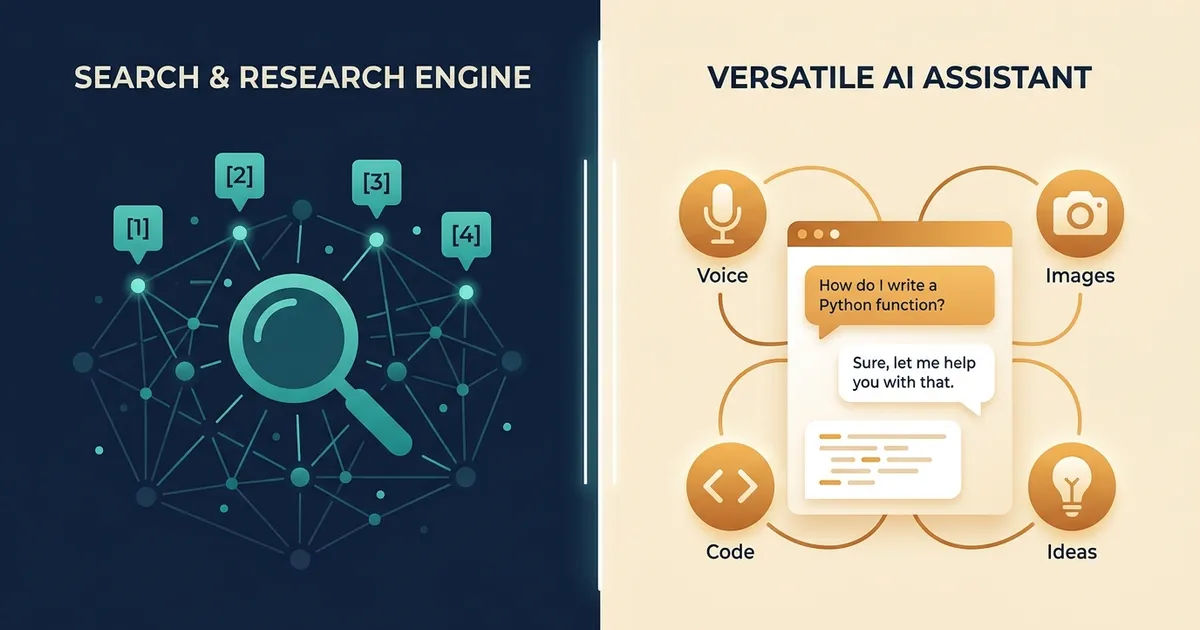
This is the single most important thing to understand before any feature comparison: Perplexity is built around search and retrieval; ChatGPT is built around conversation and generation.
Perplexity is an answer engine. It searches the web in real time, synthesises information from multiple current sources, and returns a cited, structured response where every claim links back to its origin. It's what you'd get if a search engine learned to give you a direct answer instead of ten links.
ChatGPT is a conversational AI. It draws on an enormous trained knowledge base, can reason through complex problems across a long conversation, generate creative content, write and debug code, produce images, and maintain context across extended multi-step exchanges. It's the thing most people mean when they say "AI assistant."
Neither tool is trying to be the other. The comparison question isn't which one is better, it's which one is better for what you're trying to do.
Where Perplexity Wins
Real-time research with proper citations
This is Perplexity's defining advantage and the reason it has built a loyal base of researchers, journalists, analysts, and knowledge workers. Every response includes inline numbered citations linking directly to the source material. Not a vague "according to recent reports" an actual clickable link to the specific article, paper, or page the claim came from.
The practical consequence: you can verify every claim in seconds. That changes how you use the output. Rather than treating the AI response as the answer, you treat it as a structured starting point with a pre-assembled reading list attached. For fact-dependent work, this architecture matters more than any other feature.
Source verification has tightened dramatically in 2026. False citations and hallucinated sources are rare compared to earlier versions of the tool accuracy on fact-based and trending topics, particularly in tech, science, finance, and news, is the platform's strongest suit. Perplexity is strongest on fact-based, time-sensitive topics.
Recency: the internet from today, not from training data
ChatGPT has browsing capability on Plus and above, but its fundamental architecture is trained on a knowledge cut-off. Perplexity searches the live web for every query. There's no staleness risk when you ask about a company's funding round, a scientific paper published last month, or yesterday's regulatory announcement, Perplexity is searching for the current answer.
For anyone whose work depends on current information market research, competitive analysis, news monitoring, regulatory tracking this matters. A training cut-off isn't a marginal inconvenience; it's a reliability gap on time-sensitive questions.
No advertising
In February 2026, Perplexity made a notable strategic decision: it abandoned advertising entirely. The reasoning, stated by leadership, was that ads risk making users lose trust in the answer engine. ChatGPT launched ads and hit $100 million in annualised ad revenue within weeks. Google weaves ads into approximately a quarter of its AI-generated results.
Perplexity is currently the only major AI search option without ads influencing what appears in results. For researchers and knowledge workers whose conclusions rest on what the AI surfaces, this is an underappreciated feature.
Deep Research for complex, multi-source analysis
Perplexity's Deep Research feature performs dozens of searches automatically, reads hundreds of sources, and delivers comprehensive reports in two to four minutes. For complex, multi-faceted questions a competitive landscape analysis, a literature review on an emerging topic, a regulatory summary across multiple jurisdictions this condenses hours of manual work into a structured, cited report.
Deep Research is strongest in academic, legal, and technical research. It's weaker in specialised investment data and business intelligence requiring niche proprietary databases. But for the accessible web, it performs impressively.
Access to multiple frontier models in one subscription
Perplexity Pro at $20/month gives access to GPT-4o, Claude, and Gemini alongside its own search models. If you want a single subscription that lets you route queries to the right model Claude for complex reasoning, GPT for creative tasks, Perplexity's Sonar for search it functions as an aggregator. This is genuinely convenient if you currently hold multiple AI subscriptions for different purposes.
Where ChatGPT Wins
Creative and generative work
Perplexity optimises for factuality over creativity. Its output is structured for information delivery, not creative expression. Trying to use Perplexity for fiction writing, marketing copy, brainstorming, or conceptual creative work is as one reviewer put it accurately like using a screwdriver as a hammer. It technically works, but you're fighting the tool.
ChatGPT is where creative and generative work belongs. Creative writing, world-building, nuanced tone control, and the ability to sustain a distinct voice across a long piece of writing remain areas where ChatGPT (and Claude) outperform Perplexity significantly. For drafting, iterating, and producing original content, ChatGPT's conversational depth and generative quality are materially better.
Extended conversation and context retention
ChatGPT maintains context across a long, multi-turn conversation. You can establish a problem at the start of a session, work through it iteratively across many exchanges, refine an approach, and build on previous messages with the AI retaining the full thread.
Perplexity's conversational depth is shallower. It handles follow-up questions on a research thread but isn't designed for the kind of extended, iterative reasoning sessions that ChatGPT (especially with memory enabled) handles well. For complex problem-solving that unfolds over a conversation, ChatGPT's architecture is better suited.
Coding assistance and technical tasks
ChatGPT remains one of the strongest general-purpose coding assistants. Its code interpretation, debugging, and multi-language support combined with the ability to explain code, refactor it, and work through bugs conversationally make it the default for most developers who use AI for coding tasks.
Perplexity handles coding reference questions well: comparing libraries, finding documentation, answering "what's the difference between X and Y" type queries. For actual code generation, modification, and debugging, dedicated tools like GitHub Copilot or Claude Code perform better, and Perplexity wasn't designed for this workflow.
Image generation, voice mode, and multimodal features
ChatGPT Plus includes DALL-E image generation, voice mode with video capability, and multimodal input handling. These aren't available in Perplexity. If you work across modalities generating visuals, using voice interface, analysing images ChatGPT's broader toolkit is relevant.
The ecosystem and integrations
ChatGPT has the largest integration ecosystem of any AI tool. Thousands of custom GPTs, Zapier workflows, browser extensions, API wrappers, and enterprise connectors keep it embedded in existing productivity stacks. For teams or individuals who have built workflows around AI tool integration, ChatGPT's depth of connectivity is a meaningful practical advantage.
Pricing: What You Get at Each Tier
Both tools start free and charge $20/month for their primary paid tier. The content of those tiers is meaningfully different.
Perplexity Free
Perplexity Pro ($20/mo)
ChatGPT Free
ChatGPT Plus ($20/mo)
Web search
✓ (standard)
✓ (Pro Search, 300+/day)
✓ (limited)
✓ (extended)
Citations
✓
✓
Inconsistent
Inconsistent
Deep Research
Limited
20 sessions/day
Limited
✓
Model access
Sonar
GPT-4o, Claude, Gemini, Sonar
GPT-4o mini
GPT-5.x, o-series models
Image generation
✓
✓
✗
✓ (DALL-E)
Voice mode
✗
✗
✗
✓
Custom GPTs
✗
✗
✗
✓
API credit
✗
$5/month Sonar API
✗
Separate billing
Memory
✗
✗
Limited
✓
Note: OpenAI introduced a ChatGPT Go tier at $8/month in early 2026 a mid-tier option with GPT-5.2 Instant, image generation, and file uploads for users who want more than the free plan without the full Plus commitment. Check current pricing before subscribing, as both platforms adjust their tiers regularly.
Head-to-Head: Task-by-Task Verdict
Task
Better Tool
Why
Current events research
Perplexity
Real-time search, citations, no training cut-off
Academic literature review
Perplexity
Deep Research, citable sources, cross-source synthesis
Writing a first draft
ChatGPT
Generative quality, tone control, long-form coherence
Brainstorming and ideation
ChatGPT
Conversational creativity, iterative refinement
Fact-checking a claim
Perplexity
Instant source verification
Coding and debugging
ChatGPT
Better code generation, debugging workflow
Competitive market analysis
Perplexity
Current sources, structured synthesis
Creating images
ChatGPT
DALL-E integration; Perplexity has basic generation
Multi-turn problem solving
ChatGPT
Context retention across long conversations
Quick factual queries
Perplexity
Faster, cited answers without conversational overhead
Using voice interface
ChatGPT
Perplexity lacks native voice mode
Ad-free results
Perplexity
Fully subscription-funded since Feb 2026
The Honest Limitations
Where Perplexity falls short:
Citation quality, while improved, still requires verification. Sometimes citations appear correct but are contextually inaccurate or too broad pointing to a general article rather than the specific claim. Perplexity delivers fast, sourced, real-time answers that outperform traditional search for everyday questions and simple research. But accuracy varies based on what the web provides. Always click through to verify critical claims rather than trusting the citation is as precise as it looks.
Perplexity also struggles with multi-step reasoning compared to advanced language models. Deep logic, abstract problem-solving, and nuanced inference across complex topics are not its strengths. For these, ChatGPT's reasoning models or Claude's extended thinking perform better.
Where ChatGPT falls short:
ChatGPT's citation behaviour is inconsistent. When it uses web browsing, it can cite sources but citations are not a systematic part of every response the way they are in Perplexity. For research-dependent work, the lack of guaranteed source attribution is a real limitation.
The GPT-5.x model updates have also introduced some user friction. OpenAI's safety and alignment tuning has made newer models more restrictive on certain content areas, and some users find they require more precise prompting to get equivalent results to earlier GPT-4 versions. Additionally, the $20/month Plus plan has a rate limit on reasoning-heavy queries that pushes some power users toward the $200/month Pro tier.
Who Should Use Which
Perplexity is the better primary tool if:
Your work is primarily research-intensive journalism, academia, legal, compliance, finance
You need up-to-date information where training cut-offs matter
Source transparency and verifiability are non-negotiable in your workflow
You're currently paying for multiple AI subscriptions and want to consolidate models
You want an ad-free search experience for professional research
ChatGPT is the better primary tool if:
You regularly produce written content articles, scripts, emails, reports
Your workflow includes coding, debugging, or technical problem-solving
You use AI for creative or open-ended work where generative quality matters
You need extended conversational context across complex, multi-step sessions
You rely on integrations with other tools via custom GPTs or API
Use both if:
You need to fact-check and source information for content you then draft
You're a student or researcher who writes as well as researches
You alternate between research phases and creation phases in your work
The most efficient workflow for many knowledge workers in 2026 combines Perplexity for the search and verification phase with ChatGPT for the creation and execution phase. Use Perplexity to research the current state of a topic with verified sources. Take that sourced material into ChatGPT to write the report, presentation, or article. Perplexity answers "what's happening and where's the evidence." ChatGPT answers "now help me do something with it."
FAQ
Q: Is Perplexity reliable enough for professional research?
For most professional research purposes, yes with an important caveat. Perplexity's citations have improved significantly and source verification has tightened in 2026. But citations can sometimes be contextually imprecise, pointing to related rather than precisely relevant sources. Use it to assemble a research landscape quickly, then verify the most critical claims by clicking through to primary sources. It's a research acceleration tool, not a replacement for primary source engagement.
Q: Can ChatGPT do what Perplexity does?
ChatGPT Plus has web browsing and produces cited responses when using it. But its citation behaviour is inconsistent not every response includes citations, and they're not as systematically structured as Perplexity's numbered inline format. For research where source transparency is a core requirement, Perplexity's architecture is purpose-built for it in a way ChatGPT's is not.
Q: Does Perplexity have a free tier worth using?
Yes. The free tier provides basic web search with citations and is genuinely useful for everyday research queries. The main limitations are the number of Pro Searches per day (five versus 300+ on Pro) and the model access. For light research use, the free tier handles it well. Heavy daily users will hit its ceiling quickly.
Q: Is the $20/month Perplexity Pro plan worth it over ChatGPT Plus at the same price?
This depends entirely on your workflow. If research, fact-checking, and current information are central to your daily work, Perplexity Pro's Deep Research, expanded Pro Searches, and multi-model access deliver strong value. If you write, create, code, or build as your primary AI use case, ChatGPT Plus's generative depth and broader toolkit serve you better. The most common answer among professionals who use both seriously: they keep both, assigning each to its natural workflow role.
Q: Why did Perplexity remove advertising?
In February 2026, Perplexity's leadership stated that advertising creates a structural conflict with the tool's core value proposition users need to trust that results reflect genuine information quality, not promoted placement. The decision shifted Perplexity to a fully subscription-funded model. Whether it was strategic positioning or genuine principle, the outcome is an ad-free research experience that meaningfully differentiates it from both Google and ChatGPT.
Summary
The framing of "which AI is better" is the wrong question for this comparison. Perplexity and ChatGPT are different kinds of tools that do different things well.
Perplexity is the best AI-powered research tool available in 2026. Its real-time web search, systematic citation architecture, and Deep Research capability make it the right choice whenever accurate, sourced, current information is what you need. Its ad-free model and multi-model access under a single subscription add further practical value.
ChatGPT is the most versatile AI assistant available. For drafting, creating, coding, reasoning through complex problems, and working through multi-step sessions, its generative depth, ecosystem integrations, and conversational continuity make it the default for most productive workflows.
The clearest signal for which you should prioritise: if you find yourself Googling things to fact-check AI answers, you need Perplexity. If you find yourself wishing the AI could write or create better, you need ChatGPT. If your work has both phases which it usually does both tools earn their place.
Share this article
Comments (0)
No comments yet. Be the first to share your thoughts!
Written by
Daniel Morgan
April 20, 2026
Daniel Morgan is a content writer focused on personal finance and digital tools, helping readers make practical, informed decisions. He specialises in simplifying complex topics into clear, easy-to-understand guides.
Best AI Tools for Content Creators in 2026: Write, Design and Edit Faster
From scripting YouTube videos to designing thumbnails and clipping long recordings into viral Shorts, the right AI tools can cut your production time in half without sacrificing what makes your content yours. This guide covers the tools actually worth using in 2026, organised by category with honest pricing, clear use cases, and a practical starter stack for every type of creator.